Healthcare AI and Data Exchange Sandboxes Offer a Path to Safer Innovation
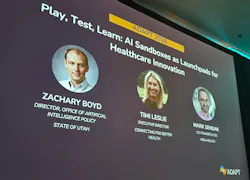
Last week in Santa Fe, NM, a panel moderated by Mark Sendak, co-founder and CEO of Vega Health, discussed AI sandboxes as launchpads for innovation at the annual ADAPT (Advancing Data Access, Privacy, and Trust) Conference hosted by the Healthcare Trust Institute (HTI).
Zach Boyd, Ph.D., director of the Office of Artificial Intelligence Policy with the State of Utah, and Timi Leslie, executive director of Connecting for Better Health, discussed Utah’s Office of Artificial Intelligence Policy and its AI Learning Laboratory, colloquially known as the AI sandbox, as well as California’s sandbox, which focuses on improving interoperability and data exchange.

“Sandboxing is really just kind of a leadership philosophy, where you face uncertainty, and you lead by doing,” Boyd said, emphasizing the value of collecting evidence while testing innovations in a governable environment.
Utah’s sandbox allows companies to apply for regulatory waivers to test certain AI applications under state oversight. One example involves Nola Health, which uses AI to support acne assessment and treatment over a 28-day period. The pilot includes escalation pathways to local dermatologists and initially requires two physicians to review AI actions, with oversight expected to decrease as safety benchmarks are met.
Boyd said these pilots help regulators understand both the benefits and risks of emerging technologies. They also let officials adjust requirements as evidence emerges, rather than trying to set perfect rules before real-world testing begins.
Independent evaluation and post-deployment monitoring are central to the approach. Boyd said AI systems may perform well in pre-deployment testing but produce different results in actual use, making continued assessment essential.
California’s sandbox, supported by Connecting for Better Health, focuses on improving interoperability and data exchange among healthcare providers, health plans and social service organizations.
Leslie described a use case involving people experiencing homelessness. The sandbox revealed that health plans and county housing systems often lacked access to one another’s information, complicating efforts to connect individuals with housing and healthcare services.
The work helped bring counties and health plans together to explore privacy-preserving ways to identify matching records and coordinate services. It also demonstrated how tested solutions could be shared with other communities rather than requiring each organization to start from scratch.
Leslie said sandboxes can make data exchange more transparent, helping organizations understand what information is available, how it moves and how it can be used.
Both panelists emphasized that building trust requires more than technical testing. Regulators, healthcare organizations, technology developers and the public must understand what is being tested, how results are evaluated and what safeguards are in place.
Boyd said his program gained credibility by publishing data, bringing in independent experts and modifying pilot protocols in response to feedback. He also highlighted the need to clearly inform patients when they interact with AI and explain how to report problems.
Patient representation remains a challenge, he added, noting that healthcare institutions and professional groups are often better organized than patients.
Panelists said sandbox models could expand through partnerships, shared evaluation standards and reusable infrastructure. Utah is developing governance guidance and evidentiary standards while exploring ways to coordinate oversight across states. California’s approach offers opportunities to reuse tested data-sharing practices across counties and healthcare organizations.
The broader lesson, participants said, is that healthcare policies and technologies should be tested before large-scale deployment whenever possible. By creating space for controlled experimentation, transparent evaluation, and collaboration, sandboxes can help healthcare leaders reduce risk, improve interoperability, and move promising innovations toward safer, more effective use.
About the Author
 Pietje Kobus-McAllister
Lead Reporter
Pietje Kobus-McAllister has an international background and experience in content management and editing. She studied journalism in the Netherlands and Communications and Creative Nonfiction in the U.S. Pietje joined Healthcare Innovation in January 2024.
Related
 AI governance
 How defensible AI unlocks innovation in health and life sciences