Rethinking Outpatient Operations Through Real-Time Data and Automation
Key Highlights
- KIO Clinic is designed specifically for outpatient settings and brings several operational tools together on one platform.
- KIO Access analyzes room occupancy and care-team activity to help clinics refine schedules and dynamically share rooms.
- The platform can alert staff to extended patient waits, notify patients when providers are running late, and help locate equipment.
- Kontakt.io’s modeled example estimates 20 percent more visits and about $6.8 million in additional annual revenue for a 100-room facility.
- The company says customer deployments are beginning, with real-world outcomes expected to be shared as they become available.
NY-based Kontakt.io, a platform that automates and orchestrates care operations, has announced KIO Clinic, a bundled technology platform designed to help health systems improve outpatient capacity, coordinate clinic operations, and increase exam-room utilization without adding rooms or providers.
The platform centers on KIO Access, an AI capability that uses infrared cameras, staff badge data, and EHR context to measure exam-room occupancy and identify scheduling opportunities. The approach does not require patients to wear tracking devices.
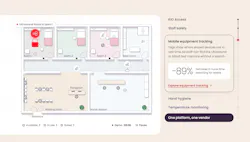
KIO Clinic also combines staff safety alerts, mobile equipment tracking, automated hand hygiene monitoring, and temperature monitoring for medication and vaccine storage. The system can notify patients when providers are running late and alert clinic staff when a patient has waited more than 10 minutes in an exam room after check-in.
The company cited exam-room utilization of about 33 percent as an opportunity to improve use of existing outpatient facilities. The company says the platform can help health systems identify workflow inefficiencies, accommodate more appointments and make better use of available resources.
“Every empty exam room represents a missed opportunity to care for another patient,” said Rom Eizenberg, Kontakt.io's chief revenue officer, in a statement.
VP Advisory at Kontakt.io, Isobel Handler, leads the team that helps health systems put Kio solutions to work in their clinical and operational workflows. Her group pairs former health system operators with technical solution architects to speed adoption and ensure every deployment delivers measurable ROI.
“We combine AI-powered RTLS (real-time location system) with fully managed IoT-as-a-Service to enable responsive care and smarter resource deployment,” Handler told Healthcare Innovation. “Kontakt is currently in use with US hospitals including HCA, Sutter, and the Veterans Administration (VA).”
Could you talk about what KIO Clinic is? Could you speak a bit about how this idea came about and what the process was to bring it to life?
Handler: KIO Clinic is the first solution that’s designed specifically for the outpatient setting. It’s centered around KIO Access, a unique technology that can measure room utilization with real-time location system (RTLS), and use those insights to optimize appointment scheduling and patient flow, no patient tagging required. Alongside KIO Access, KIO Clinic also includes staff safety, asset tracking, hand hygiene, and temperature monitoring, to address all of an outpatient clinic’s operational needs.
A lot of our thinking came from feedback from our customers. We kept hearing that expanding access was a strategic priority as demand for ambulatory care continued to grow. Yet much of the RTLS technology available to health systems had traditionally focused on acute care. We saw an opportunity to bring those capabilities into clinics, where so much of Americans’ everyday healthcare takes place.
We wanted to build something around the specific needs of outpatient care. That meant addressing both strategic priorities, like increasing access and making better use of existing space, and everyday operational needs, like staff safety and equipment availability.
To bring that into reality, we worked with long-standing customers and new customers in the ambulatory space to understand their workflows, constraints, and priorities. Those conversations shaped a bundle of solutions designed for how clinics actually operate. The solutions address different use cases but share one platform and infrastructure, giving clinics access to sophisticated technology in a way that fits their setting.
The news release says KIO Clinic can help health systems increase visits and revenue per exam room without adding rooms or providers. What specific results support that claim, and under what conditions can health systems realistically achieve them?
Handler: Most exam rooms are occupied only about 33 percent of the time. To understand why, start with the traditional allocation of two exam rooms per provider. With a provider seeing one patient at a time, that model starts with a practical utilization ceiling of roughly 50 percent.
Then consider that most providers are not in the same clinic Monday through Friday, nine to five. They split their time across inpatient duties, other clinics, operating rooms, and other responsibilities. Unless those rooms are reassigned, they can sit unused during those periods, bringing utilization down to approximately 40 percent. Scheduling templates and unfilled appointment slots create additional gaps, taking actual occupancy to around 33 percent.
KIO Access addresses this in three steps. First, it makes unused capacity visible, showing where and when rooms are underutilized. Second, it helps align scheduling templates with reality: How long do different visits actually take? Where do appointments consistently run over? Where are we leaving usable time unfilled?
Finally, real-time dynamic rooming allows clinics to share rooms based on actual availability and care-team readiness. That can move a clinic from two rooms per provider toward 1.5—for example, six rooms shared by four providers. Together, these changes create opportunities to accommodate more visits within the existing footprint. The gains depend on the clinic’s starting point, patient demand, and available clinical capacity.
What measurable results can a health system expect in exam-room utilization, patient throughput, and revenue?
Handler: We look at three things: can we help a health system see more patients, generate more revenue from its existing rooms, and avoid building space it doesn’t yet need?
To put some numbers around that, we modeled a medical office building with 100 exam rooms. By bringing providers into unused clinic sessions, adjusting scheduling templates to reflect how long visits actually take, and sharing rooms more efficiently, we estimated an opportunity to accommodate about 27,000 additional visits a year—a 20 percent increase over baseline. At $250 in net revenue per visit, that translates to roughly $6.8 million in additional annual revenue.
Seeing those patients in existing space could also avoid the need to build approximately 20 net new exam rooms, representing about $2 million in construction costs.
That’s an illustrative model, and the opportunity will be different for every health system. We start by understanding where capacity is going unused and what changes are feasible. The financial results matter, but the reason to do this is to help more patients get care sooner. We love to see health systems seeing big improvements in their tracked access metrics.
Can you share a real-world customer example with before-and-after results?
Handler: KIO Clinic is at the leading edge of outpatient care operations, and we’re still early in its rollout, so we don’t yet have a live customer reference to share. Several customer go-lives are happening beginning this month, and we’re excited to share their experiences and measurable results as they become available.
How does KIO Clinic turn room-occupancy data into actionable scheduling and workflow improvements?
Hander: Each exam room is equipped with a thermal camera and the infrastructure to locate a staff member’s call for help down to the room. Clinic staff wear a duress badge that lets them immediately request assistance if a situation with a patient or visitor is escalating, so security or nearby colleagues can respond and help de-escalate.
That same badge, combined with room-occupancy data and information from the electronic health record, helps us understand which staff members are participating in a visit and build a timeline of what actually happens. We can see how long patients wait, how much time staff and providers spend with them, and how long a room waits to be cleaned between visits.
We use that information in two ways. First, we compare the schedule with what actually happened. Do appointment lengths reflect how long visits take? Where do delays consistently occur? Where could we accommodate additional visits?
Second, we help teams respond throughout the day. That means flagging when a patient has waited too long or a room has been awaiting cleaning, and supporting dynamic room assignments. Instead of reserving the same rooms for one provider all day, clinics can share rooms based on availability and care-team readiness, allowing more providers to practice within the existing space.
How is the data secured, and what controls do health systems have over access, retention, and use?
Handler: Kontakt.io provides enterprise-grade data encryption that adheres to legal standards and healthcare requirements, including HIPAA, SOC2, GDPR, and HITRUST (coming in 2027). Data received from EHR integrations and our real-time location systems is encrypted end-to-end, and we work with each health system to meet its unique requirements for data retention and access to its own data.
We also recognize that the value extends beyond the initial use case. A health system might use these insights to identify staffing opportunities, build a business case for a capital investment, or understand how its clinics operate across different locations. We make the data available in several ways so teams can use it within their own analytics and planning processes, subject to the appropriate access and privacy controls.
What other features would you like to highlight?
Handler: I’d highlight the patient experience opportunity. That starts with access: helping patients get an appointment sooner. But it also extends to what happens before and during the visit.
With KIO Clinic, we can identify when appointments are running behind and notify patients, potentially before they’ve even arrived at the clinic. Once they arrive, we can flag excessive waits so staff can intervene. We also help staff locate equipment and supplies, reducing delays that interrupt a visit.
Patient surveys are valuable, but they usually tell us about an experience after it has happened. KIO Clinic adds a more detailed view of the operational factors that shape that experience: how long someone waited, where delays occurred, and whether the team had what it needed. That gives health systems an opportunity to address problems while the patient is still there and make improvements over time.
How difficult is it to integrate the platform into a health system's existing EHR and operational infrastructure?
Handler: KIO Clinic’s devices, such as infrared cameras, staff badges, device trackers, or temperature probes, can be installed rapidly during off-hours; integrating KIO Clinic into your EHR takes weeks, not months.
What do hospital leaders need to rethink about outpatient operations as more care moves beyond the hospital?
Handler: The first thing is to look for opportunities to meet growing demand within the space we already have. Before deciding we need another building or more exam rooms, we should understand how well we’re using our existing rooms and how quickly we could make more appointments available.
We also need to be open to redesigning how care is delivered. Do we have the right mix of clinical skills in the clinic to meet patients’ needs? Can we adjust staffing throughout the day as the schedule changes or unexpected needs arise?
The same thinking applies to supplies and equipment. Whether a visit requires a vaccine or a mobile ultrasound, teams need to know that it’s available, accessible, and ready to use. Otherwise, we risk delaying care, leaving equipment unused, or wasting supplies because they haven’t been stored or maintained appropriately.
It’s crucial to have tools that help staff feel safe at work and confident that what they need is ready, easy to find, and reliable. Those tools should handle routine operational checks and flag issues as they arise, taking that burden off care teams so they can focus on their patients.
Do you see the future of outpatient operations moving toward more automated, real-time coordination across scheduling, staffing, rooms, and equipment?
Handler: Yes, I think that’s clearly where outpatient operations need to go. Patients increasingly expect the ease and visibility they experience when booking a restaurant reservation or an airline ticket. They want to find an appointment that meets their needs, understand what’s available, and know when something changes. We need schedules that better reflect patient demand and the flexibility to respond as new needs arise.
Behind that experience, a lot has to come together: the right staff, an available exam room, working equipment, and the necessary medical supplies. Managing all of that creates a significant burden for clinic teams.
The opportunity is to have technology monitor those things in the background, coordinate resources, and flag exceptions that need someone’s attention. That makes coordination a seamless part of delivering care and allows staff to spend more of their time with patients.
What capabilities or developments should hospital leaders expect next from Kontakt.io?
Handler: I see KIO Clinic expanding beyond the exam room into other ambulatory settings, including radiology, infusion, and urgent care. Each has its own workflows and needs, but they share the challenge of bringing together the right people, space, equipment, and supplies when a patient needs them. Our vision is to support that coordination wherever care is delivered, with tools that fit the way each setting operates.
About the Author
 Pietje Kobus-McAllister
Lead Reporter
Pietje Kobus-McAllister has an international background and experience in content management and editing. She studied journalism in the Netherlands and Communications and Creative Nonfiction in the U.S. Pietje joined Healthcare Innovation in January 2024.