Five Healthcare Innovations Earn Bronze Honors in 2026 Impact Awards
Key Highlights
- Kalogon’s 3D-printed Verro cushion uses variable-density lattice technology to tailor pressure relief, support and airflow.
- MedeAnalytics Social Risk Insights combines social risk information with clinical and financial data to help health plans identify populations for targeted interventions.
- Rainfall Health’s platform helps hospitals operationalize CMS TEAM requirements and monitor quality and performance measures.
- Relatient’s Dash Voice AI automates or routes scheduling and other patient calls through workflows connected to its scheduling platform.
- Valify’s spend intelligence platform uses categorized spending data, benchmarks and opportunity scoring to help hospitals prioritize purchased-services savings.

The 2026 Healthcare Innovation Impact Awards Bronze winners demonstrate how technology can address challenges across healthcare delivery and operations, from helping hospitals navigate new payment requirements to identifying social risks, personalizing mobility equipment, managing purchased services spending and improving patient access.
Kalogon, MedeAnalytics, Rainfall Health, Relatient and Valify were recognized for solutions designed to help healthcare organizations respond to complex needs with more targeted information, streamlined workflows and practical tools.
Here is a closer look at the five Bronze-winning solutions.
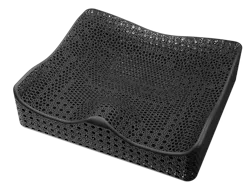
Kalogon's Verro custom wheelchair cushion
For people who use wheelchairs, seating is about more than comfort. Appropriate positioning, pressure distribution and stability can affect daily function and quality of life, particularly for people with complex postural or seating needs.
Kalogon's Verro is a custom wheelchair cushion that uses three-dimensional printing and variable-density lattice technology to create a body-conforming seating surface. Its design allows different areas of the cushion to provide different levels of firmness, supporting individualized pressure relief and postural needs.
Traditional cushions may use a more limited range of foam densities or material layers. Verro's approach allows the cushioning structure to be adjusted at a more localized level, creating softer areas where pressure relief is needed and firmer areas where support is important. The open lattice structure is also designed to promote airflow and manage the seating microclimate.
Kalogon reports an average delivery timeframe of approximately 14 days for Verro and its custom seating products, compared with industry processes that may take 30 days or longer. The company also reported an average of 6.5 days from order to shipment for its custom products in June 2026.
The product reflects a broader opportunity to combine individualized design with digital manufacturing processes. For people who need specialized seating, the ability to tailor a cushion to individual requirements while reducing production time can be meaningful.
Learn more about Verro.
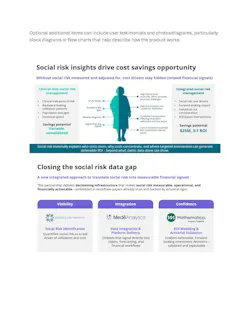
MedeAnalytics Social Risk Insights
Social factors can influence healthcare utilization, outcomes and costs, but their effects may not be fully visible in traditional claims-based analytics. MedeAnalytics Social Risk Insights is designed to help health plans better understand how social risks intersect with clinical and financial information.
The solution aims to identify members whose social circumstances may contribute to elevated healthcare needs or costs. By bringing social risk information into the analysis, health plans can look beyond clinical diagnoses alone when assessing populations, prioritizing interventions and evaluating opportunities to improve outcomes. The distinction is important for organizations operating under value-based contracts, where understanding differences in patient needs can influence care management strategies and resource allocation.
In its awards submission, the company describes an analysis of a commercial health plan population of approximately 450,000 members. Social risk stratification identified five high-risk cohorts that were not apparent through claims data alone. The analysis projected that interventions addressing social risks across those groups could generate up to $25 million in savings, with a projected three-to-one return on investment.
Those figures represent projected opportunity rather than guaranteed savings. Actual results would depend on the interventions implemented, the populations served and the organization's ability to address the underlying risks. The broader opportunity is to give health plans a more complete view of the people they serve and use that information to target resources more effectively.
Learn more about MedeAnalytics.
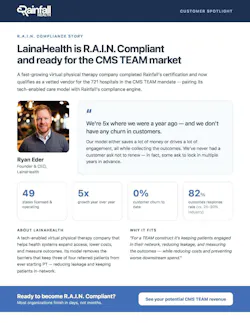
Rainfall Health Platform
Hospitals participating in the Centers for Medicare & Medicaid Services' Transforming Episode Accountability Model (TEAM) face new responsibilities for managing costs and quality across designated surgical episodes. For affected organizations, understanding the requirements and coordinating care across settings can create significant operational demands.
The Rainfall Health Platform is designed to help hospitals translate CMS TEAM requirements into actionable workflows. Its AI-powered framework, known as R.A.I.N., is intended to help organizations interpret complex regulatory guidance, coordinate care and monitor performance measures associated with the model.
Rather than treating compliance as a document-review exercise, the platform focuses on operationalizing requirements and helping hospitals track the activities that affect performance. That may be particularly relevant for rural, safety-net and other resource-constrained hospitals that must meet new obligations without necessarily having large teams dedicated to regulatory implementation.
Rainfall Health's awards submission describes capabilities for estimating composite quality scores and monitoring measures such as readmissions and surgical outcomes. The company also highlights the potential financial significance of TEAM participation, under which performance can affect hospital payments.
For health system leaders, the challenge extends beyond understanding a new payment model. Organizations must build the processes, data visibility and cross-continuum coordination needed to respond to their requirements.
Learn more about Rainfall Health.
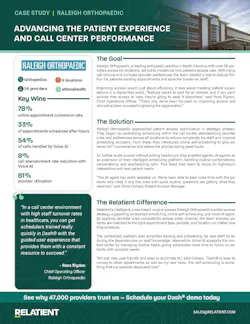
Relatient's Dash Voice AI
Patient access teams manage high volumes of phone calls involving scheduling, cancellations, rescheduling and other requests. These interactions are essential to the patient experience, but repetitive administrative work can consume staff time and make it harder for organizations to respond efficiently.
Relatient's Dash Voice AI is designed to automate many of these interactions using AI grounded in the company's Dash intelligent patient scheduling platform. The solution can handle scheduling-related requests and route clinical, billing and other patient requests into an organization's electronic medical record as structured tasks.
The platform's connection to existing scheduling rules is intended to help it work within established workflows rather than operate as a generic conversational layer disconnected from the systems staff use.
Relatient reports that Dash Voice AI answers 62% of inbound calls, with 72% of those calls either handled autonomously or intelligently escalated within the organization. The company also reports that more than 60% of appointment cancellation calls and up to 50% of appointment management calls can be completed end to end by the system, with some clients reporting higher rates for cancellation handling.
These measures point to the potential for AI to reduce routine call handling and help staff focus on interactions requiring human attention. As with other patient-facing AI applications, implementation requires careful attention to accuracy, escalation pathways, privacy and the ability to route requests appropriately.
For healthcare organizations seeking to improve access while managing staffing demands, voice AI offers one possible way to streamline routine interactions without losing sight of patient needs.
Learn more about Dash Voice AI.
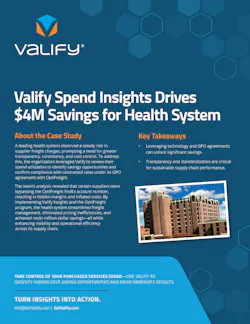
Valify's healthcare spend intelligence platform
Healthcare organizations face persistent financial pressure, and purchased services can represent a complicated area of spending to manage. Hospitals work with numerous vendors, contracts and service categories, often across fragmented data sources that make it difficult to compare costs and prioritize opportunities.
Valify's spend intelligence platform is designed to help hospitals and health systems identify potential savings in purchased services. It combines categorized spending data, benchmarking, market insights and tools to help organizations evaluate opportunities and determine which initiatives to pursue.
Its Valify Insights capabilities include dashboards, indicators and initiatives intended to help supply chain and finance leaders assess performance and prioritize action. A proprietary scoring approach is designed to rank opportunities according to factors such as potential impact, readiness and value. The platform is intended to help organizations move from simply understanding their spending to identifying specific areas for review and improvement.
Valify reports that its dataset includes $1.3 trillion in categorized spending, more than 2,600 hospitals, approximately 447,000 beds and more than 645,000 vendors. The company also reports that clients commonly achieve savings of 10% to 30% in targeted categories. Those figures are vendor-reported measures, and individual results will depend on the categories examined, the opportunities identified and the organization's ability to implement changes.
For health system finance and supply chain leaders, improved visibility into purchased services can help focus limited resources on the opportunities most likely to deliver financial and operational benefits.
Learn more about Valify.
Innovation across the healthcare landscape
The Bronze winners illustrate the range of challenges healthcare organizations are working to solve. Regulatory readiness, social risk identification, customized mobility equipment, spending intelligence and patient access may seem like distinct areas, but each affects an organization's ability to deliver effective, efficient and responsive care.
These solutions also highlight the importance of evaluating innovation in practical terms: what problem does it address, how does it fit into existing workflows, and what evidence supports its value?
Congratulations to Kalogon, MedeAnalytics, Rainfall Health, Relatient and Valify on their 2026 Healthcare Innovation Impact Awards Bronze honors.
Related content
Healthcare Innovation Announces 2026 Impact Awards Winners
Three Healthcare Innovations Earn Gold Honors in 2026 Impact Awards
Three Healthcare Solutions Earn Silver Honors in 2026 Impact Awards
About the Author
 Melinda Taschetta-Millane
Market Content Director
Melinda Taschetta-Millane is Market Content Director of Healthcare Editorial, and Head of Content for Healthcare Innovation.