How Hospital at Home Pioneers See the Model Evolving
Key Highlights
- Leaders say the next phase of hospital at home must prove programs can deliver care more efficiently and reach more patients across more health systems.
- An aging population and limited hospital capacity strengthen the case for making home-based hospital care part of mainstream healthcare.
- Clear leadership priorities, easier patient intake and ongoing clinician feedback can support growth alongside other home-based services.
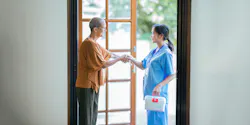
At this week’s Hospital at Home User Group annual meeting, a panel of home-based care pioneers spoke about how they think the model will evolve and opportunities for growth over the next several years.
David M. Levine, M.D., M.P.H., M.A., clinical director of research and development for Mass General Brigham’s Health Care at Home program, said there’s a big opportunity in rural areas. “One in five people in the United States live in rural areas, and we don't have a lot of experience delivering hospital at home in rural areas,” Levine said. “We just finished a large multi-site randomized control trial of demonstrating the impact of home hospital in rural areas. It's a really valuable care model. We're now launching a rural home hospital accelerator to try to accelerate rural areas implementing the care model, so I think it's a super exciting time for expanding services to new populations.”
Levine discussed other new patient phenotypes that could be a fit for home hospital. He mentioned pathways in obstetrics and gynecology in home hospital. "At Mass General Brigham, we have had extraordinary success with a postpartum hypertension pathway,” he said. “We’ve seen across the country post-caesarean section pathways. We are seeing some really cool partnerships with neurology for MS and myasthenia gravis.” Another example is in the oncology field, which is seeing that hospital at home can serve its patients well, he said. “These are patients who spend a lot of brick-and-mortar time, and they don't want to.”
Albert L. Siu, M.D., M.S.P.H., who served as the first director of Mount Sinai at Home, said that over the next couple of years these programs “need to show that we can improve the logistics and that we can do it more efficiently. The question has changed. We were initially asking a number of years ago whether it was safe to do and whether it people would be willing to do it. I think we now have to ask the question, can we do it better? Can we do it more efficiently? Can we do it for more people in more places?”
Liu said he thinks hospital at home programs must grow. “I think it's a matter of grow it or go home,” he said. “We’ve already shown that we can do hospital at home in some health systems and for some patients. I think that we need to show in the next five years that we can do hospital at home in many health systems and for many more patients.”
Bruce Leff, M.D., M.B.A., M.P.H., a professor of medicine at the Johns Hopkins University School of Medicine and co-lead of the Hospital at Home Users Group, said there is a demographic imperative for home hospital. By 2030, 20% of the population will be over the age of 65, with lots of chronic illnesses, and there will simply not be enough beds to care for these people, he said. “We cannot, in my humble opinion, build those beds for lack of capital and for lack of time. Hospital at home can start to bring that change in cultural alignment and it can start to be thought of not as a redheaded stepchild, but as part of the core of healthcare delivery.”
Linda DeCherrie, M.D., vice president for clinical strategy and care delivery at DispatchHealth, mentioned several things that she thinks need to happen for hospital at home to scale well. First, health system leadership needs to say this is a priority. In addition, she said, we need the internal systems to be clear so that it's easy to bring a patient into home hospital. “We also need to provide continuous feedback to clinicians of the successes of their patients in the model. Once we do all of those things, then it's going to become just another part of the health system,” she said. “No one questions the observation unit anymore. No one questions that we have specialized cardiac or other units, right? We need this to be just like that.”
DeCherrie predicts health systems are going to develop more ecosystems of home-based services that grow along with hospital at home. “Some programs are going to do waiver hospital at home, some programs are going to do non-waiver hospital at home, or early supportive discharge, or obs at home, or home-based primary care, or home-based palliative care and use similar resources for the problems they have in their health system that they want to try to solve with it,” she said.
Levine noted that home hospital has demonstrated that it can reduce patient safety events that often lengthen hospital stays and have downstream impacts. As home hospital continues to grow, it needs to continue to demonstrate those downstream impacts, he said. “We need to make sure that we are actually executing on care model changes and delivering care to certain patient phenotypes that actually bends the cost curve for the country. Otherwise, we're way less relevant than we'd like to think.”
About the Author
 David Raths
David Raths is a Contributing Senior Editor for Healthcare Innovation, focusing on clinical informatics, learning health systems and value-based care transformation. He has been interviewing health system CIOs and CMIOs since 2006.
Follow him on Twitter @DavidRaths