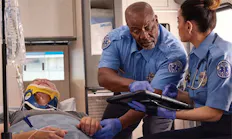
HealthTap Connects Patients, Doctors and DME Suppliers
Key Highlights
- HealthTap's sleep care pathway can support home sleep test referrals, diagnosis, initial CPAP orders, resupply and compliance visits.
- Electronic integrations aim to reduce manual paperwork and delays for patients, clinicians and DME suppliers.
- HealthTap says its DME partnerships are operational and scaling, including a publicly announced partnership with Aeroflow Health.
Virtual primary care provider HealthTap has struck up partnerships with continuous positive airway pressure (CPAP) suppliers to support patients with ongoing clinical re-evaluations, compliance visits and new orders. It is just one way HealthTap CEO Sean Mehra says virtual primary care can support care at home, connecting the clinical decisions, information and follow-through needed to keep treatment moving.
Mehra recently spoke with Healthcare Innovation about the company’s approach to partnerships, including with durable medical equipment (DME) suppliers.
Healthcare Innovation: Sean, could you start by describing what differentiates HealthTap from other companies in the telehealth space?
Mehra: We are a nationwide virtual primary care practice. We focus on relationship-based primary care, where you get to choose and keep one doctor, which is fairly different from traditional telehealth, where you have the first available doctor or nurse picking up to triage you and they never see you again.
That expands the clinical scope of what we can manage with patients, which actually helps us take on one or more chronic conditions that plague so many Americans, and of course even preventative and wellness assists like catching cancer early and keeping your blood pressure in check.
We also work across not only all geographies but all payer types. We pride ourselves on being accessible, whether you have commercial insurance or government insurance like Medicare or Medicaid, or are uninsured. In terms of recent growth or partnerships, HealthTap is very much a venture-backed growth stage business, and our momentum is defined by commercial partnerships, which I think speak to the diversity of ways we're reaching patients, which are both very direct consumery, but also very enterprisey. Pardon the lack of technical terms.
HCI: I saw one example is a partnership with Samsung, right?
Mehra: On the more B2B2C side of the house, you'll have consumer retail partnerships like Samsung or Albertson’s, the grocery store chain, or even Lilly Direct, the pharma website for direct to consumer engagement. These are examples of consumer distribution channel partners who re-market and bundle HealthTap services as part of a value proposition that they're trying to affect, each one being slightly different. But on the other side of the house, we'll do enterprise relationships with groups like Christian Healthcare Ministries, a large faith-based cost share. It's not quite health insurance, but they can subsidize the cost of care for their members. Or we have partnerships with health plans, where it's the much more traditional form of billing insurance for the care we're providing their members.
In the middle sit interesting things like the announcement we're doing today, which follows the announcement about our partnership with Aeroflow Health in the DME space. Today we deepen that strategy. We're not charging our DME partners for care. They don't provide care. They don't resell care, but they have something innately valuable to make sure that the patients who need their supply get timely access to a doctor in a way that is a win-win-win.
HCI: So let's talk about the the traditional way that sleep apnea patients who need a CPAP get it approved and get the equipment. Where is there a breakdown in that system that HealthTap is setting out to address?
Mehra: There are tens of millions of undiagnosed Americans who first need a home sleep test ordered. Once it is ordered and fulfilled by a sleep medical group with sleep doctors, it results in some sort of risk score of your likelihood of having sleep apnea. Your doctor needs to review the score and say, "Yes, I'm going to diagnose you with sleep apnea, and now I'm going to order you DME.” So diagnosis to initial supply is one part of the funnel.
There are usually three moments in a patient's journey once they're on any sort of CPAP treatment that require re-engaging with a doctor. It is typically resupply, which is the tubes and masks, the disposable stuff that you need to get much more frequently renewed. There's re-PAP. Somewhere between every three to five years you need a brand new machine because there's a shelf life to the machine. Then there are compliance checks of whether you are using the device appropriately. That is something that a lot of insurers require to prevent fraud, waste, and abuse and unnecessary use of DME.
These are all moments that create friction due to poor access that result in disruption in supply, disruption in treatment, worse outcomes, and loss of revenue to the DME suppliers. Not to mention the visits that are required to fill out this administrative paperwork for DME are not very coveted by the doctors who referred the patient in the first place. They're very low-value, administrative visits.
HCI: Can the HealthTap virtual doctor do the initial ordering of a sleep test, assessing the score and ordering the DME?
Mehra: Yes. Part of our end-to-end sleep journey launch starts there. When our doctors conduct the clinical screening for risk of sleep apnea and suggest a home sleep test is appropriate,, they refer you to sleep medicine, and we have preferred partners and integrated partners, and sometimes the home sleep test is facilitated through a warm handoff to one of these partners. But we can do the initial ordering of the test, receive the result back, and then make the diagnosis and do the initial supply order. What's neat is as we take on more DME partners, the submission of the DME order becomes electronic and facilitated as well. So it's not like the patient is told here's the printout PDF that you need to email or send to your DME provider manually. You just push this button and just like any prescription that went to Walgreens, it'll go to one of the DMEs in the drop-down that we've integrated with.
HCI: Does the fact that you're connected and integrated with some of the DME providers give them more information about the patient's journey?
Mehra: It has more to do with removing the friction and time waste from both the patient and the provider than necessarily more data to the DME provider. For the DME, at the end of the day, it's about preventing disruption in supply, preventing loss in revenue, preventing loss in a patient relationship, and faster speed to fulfillment. That's what they get.
The technology integrations are preventing redundant data entry for the patients. Obviously, the videoconferencing medium enables convenience and access for patients, which is part of the experience benefit. For the providers, it offers not only all of the interviewing and data entry capture, but also the templating and electronic submission of the order. So both what the doctor needs to physically type and enter in or ask the patient is semi-automated, but also the back office, which is after the visit, everything that needs to be sent to the DME in the exact format it needs to be sent. There's no three or four phone calls back and forth saying you forgot to check this box and sign your name on this line. All of that is gone because the computer is doing it exactly the way the DME needs it.
A very large DME supplier told me that they have 600 people whose sole job it is to chase doctors' offices for paperwork. There's just so much cost savings that comes out of the system when all of a sudden you don't need humans making phone calls to fill out a form a certain way.
HCI: Earlier you mentioned a partnership with Aeroflow. Is this something that's operational with a bunch of the DME providers already, or is it where you are looking to go?
Mehra: Aeroflow is our publicly announced partnership. We are operational with other partners, some quite large that we have yet to announce. We will announce them in due time once we have approval. But it is operational and scaling, especially for resupply and rePAP.
HCI: Can you envision other examples of the way the timeliness of the virtual primary care could solve bottlenecks and provide feedback in ways that traditional in-person primary care clinics can't do today? Are there other markets that would make sense to go after in the same way you have with this?
Mehra: Absolutely. If you look at some of the biggest categories of DME supply in this country, CPAP is one of them. There's CGM [continuous glucose monitoring] as well. There’s urology, so all incontinence-related supplies from catheters to diapers to bed sheets. There's maternity, so things as simple as like compression socks, for which there's very little contraindication, but a lot of paperwork just to get something so simple to prevent DVT. And finally, I'll say oxygen concentrators for people who need extra oxygen. So those are the categories where we have already had some experience, or are in the middle of broadening our DME capability beyond them.
HCI: Everyone we talk to these days is saying how AI is revolutionizing what they do. Is it having a big impact within the EHR that your virtual primary care docs practice in?
Mehra: I feel there’s a lot of noise around AI, but substantively, if you think about what it can do well right now, it's really, really good at doing what it does in business meetings, which is transcribe and summarize for all parties what was discussed. So even in the patient/doctor context, that's a valuable service it can do at marginal cost. There are elements of clinical decision support it can lend the physician, which I think are neat, and I think data is beginning to show that ultimately the augmentation of physician plus AI leads to more accurate diagnoses when audited and measured. So I think that is interesting and value-added, though it very much requires a human in the loop make the final call.
The other one is actually quality assurance. Normally you'd want to audit 10% of all your clinical notes for each physician with their peers, and make sure in the practice everyone's following evidence-based protocols, such as not over-prescribing antibiotics. AI lets you audit 100% of them every day, right? And humans just have to come in and look at the edge cases. Physicians get comprehensive, timely feedback to make them better doctors. Because a lot of doctors, when they make mistakes, they want to learn. They're very growth-minded in that sense. AI does give them that timely feedback in a way that a human reviewer just couldn't.
HCI: Does your company use a homegrown EHR system or a customized one?
Mehra: We use our own homegrown proprietary EHR. That was part of what enabled us to be able to do partnerships like with DME vendors because we control the full workflow for the patient and provider. We're fairly deep on the integration. We're not waiting for a third-party software vendor to change a button on a screen. That was strategic and important for us. But it also now allows us to be intentional and controlled as we do rollout and integration of AI as an intelligence layer in different workflows. We were very early in launching what we call our agent, Doctor AI. We were very early in making it do visit intake and patient interviews. We launched it as early as 2017, I believe, before ChatGPT even existed. But then we were much more measured about having it do other fancy things that other folks are doing, perhaps a little bit more fast and loose than we want to be. Anyway, I like having that level of control in getting to choose how we roll it out.
About the Author
 David Raths
David Raths is a Contributing Senior Editor for Healthcare Innovation, focusing on clinical informatics, learning health systems and value-based care transformation. He has been interviewing health system CIOs and CMIOs since 2006.
Follow him on Twitter @DavidRaths
Related
 dreamstime_xl_317656506